

My husband, the perfectionist
|
|||
Related Links
Tributes : Stylish in the trenches
Harsha Bhogle : The wolf who lived for the pack Sambit Bal : Your regular, everyday superstar
Players/Officials:
Rahul Dravid
Teams:
India
|
|||
I've been married to Rahul for almost nine years now and we have always
been very private people. So I'm sure he will be astonished to find that
I have written at length about him.
This is not meant to be a song of praise for him on his retirement; that
is up to the rest of the world. I am his wife, not a fan, and the
reason I am writing this is to give you an insight into the role cricket
has played in his life, and to take that in for myself at the end of
his 16-year international career.
Just after we got married, I remember him saying to me that he hoped to
play for "the next three or four years", and that he would need me there
to support him in that time. Now that he has retired, I think: "Not
bad. We've done far better than the three or four years we thought about
in May 2003."
The last 12 months were special for us for more reasons than the runs or
centuries Rahul has scored. After the 2010-11 tour of South Africa, our
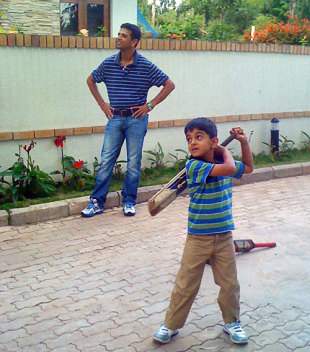
older son, Samit, suddenly developed a huge interest in cricket. When
he watched Rahul score his centuries in England last year, it was as if
in the last year of his career, Rahul had found his best audience.
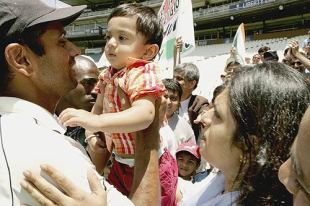
I was with the boys at Old Trafford when Rahul played his first (and
last) Twenty20 international and then also travelled to every match of
the one-day series. After the last ODI, we went into the Lord's dressing
room and showed Samit and Anvay their baba's name on the honours
board. It was a huge thrill for the boys to see Rahul play live in
front of so many people, to see him at his "work", which kept him away
from them for months.
Cricket has been the centre of Rahul's world and his approach to every
season and series has been consistent in all the time we have been
married. Methodical, thoughtful and very, very organised. When I
travelled with him for the first time, in Australia in 2003-04, I began
to notice how he would prepare for games - the importance of routines,
and his obsession with shadow practice at odd hours of day or night. I
found that weird. Once, I actually thought he was sleepwalking!
Now I know that with Rahul's cricket, nothing is casual, unconscious or
accidental. Before he went on tour, I would pack all his other bags, but
his cricket kit was sacred - I did not touch it; only he handled it. I
know if I packed only two sets of informal clothes, he would rotate them
through an entire tour if he had to and not think about it. He has used
one type of moisturising cream for 20 years because his skin gets dry.
Nothing else. He doesn't care for gadgets, and barely registers brands -
of watches, cologne or cars. But if the weight of his bat was off by a
gram, he would notice it in an instant and get the problem fixed.
Cricket has been his priority and everyone around him knows that. On
match days Rahul wanted his space and his silence. He didn't like being
rushed, not for the bus, not to the crease. All he said he needed was
ten minutes to himself, to get what I call his "internal milieu"
settled, before he could go about a match day.
When we began to travel with the kids - and he loved having them around
during a series, even when they were babies - we made sure we got two
rooms. The day before every game, the boys were told that their father
had to be left alone for a while, and Rahul would go into his room for
his meditation and visualisation exercises. On the morning of the game,
he would get up and do another session of meditation before leaving for
the ground. I have tried meditation myself and I know that the zone he
gets into as quickly as he does - it takes lots of years of training to
get there. It is part of the complete equilibrium he tries to achieve
before getting into a series.
Like all players, Rahul has his superstitions. He doesn't try a new bat
out for a series, and puts his right thigh pad on first. Last year
before the Lord's Test, he made sure to sit in the same space
Tillakaratne Dilshan had occupied in the visitors' dressing room when he
scored nearly a double-hundred earlier in the season. Rahul scored his
first hundred at Lord's in that game.
| If I packed only two sets of informal clothes, he would rotate them through an entire tour if he had to and not think about it. He doesn't care for gadgets, and barely registers brands - of watches, cologne or cars. But if the weight of his bat was off by a gram, he would notice it in an instant and get the problem fixed | |||
Once the game is on, at the end of every day he has this fantastic
ability to switch off. He may be thinking about it, his batting may
bother him, he will be itching to go back and try again, but he can
compartmentalise his life very well. He won't order room service or
brood indoors, he would rather go out, find something to do - go to a
movie or watch a musical, which he loves. He will walk out to the sea to
wind down or go to bookstores, or find something else to do.
He has dealt with all that goes on in cricket because he can separate
the game and the rest of his life and put things in perspective. No
matter what was happening in his cricket, at home he is husband, father,
family man. He has never said, "Oh I've had a bad day." He wouldn't
speak about his work unless asked. Other than dropped catches.
Only once, I remember, he returned from a Test and said, "I got a bit
angry today. I lost my temper. Shouldn't have done that." He wouldn't
say more. Many months later, Viru [Sehwag] told me that he'd actually
thrown a chair after a defeat to England in Mumbai. He'd thrown the
chair, Viru said, not because the team had lost but because they had
lost very badly.
One of Rahul's great strengths is his ability - and he has had it all
along - to accept reality. He believes you cannot complain about
anything because there is no end to complaining. And he knows there is
no end to improving either. He always looks within, to gain, to learn
and to keep working at his cricket.
In the last few years he worked doubly hard to make sure he played the
game in his best physical condition in the toughest phase of his career
physically. He tried to understand his body and work on his limitations -
he was able to hold off shoulder surgery despite a problem in his
rotator cuff because he found ways to keep it strong. When I was
pregnant with Samit, we spent two months in South Africa to work in a
sports centre that focused on strengthening Rahul's shoulder. Because he
sweats profusely, he has even had sweat analysis done, to see how that
affects his batting. He found that Pat Rafter, the former Australian
tennis player, had a similar problem.
To get fit, he went on very difficult protein diets for three months at a stretch, giving up rice, chapatis
and dessert altogether - even though he has a sweet tooth. He wanted
his batting and his cricket to benefit from his peak fitness, even
heading into his late 30s. He has been to see a specialist in eye
co-ordination techniques, for eye exercises for the muscles of his eyes.
If there was a problem, he always tried to find answers.
Outside cricket, Rahul is a man of no fuss. If he's on a diet, he will
eat whatever is served, as long as it fits the diet. Even if the same
food keeps turning up on his plate for days in a row, he will eat it
without complaint. If he drops a catch, though, it bothers him enough to
talk about it on the phone when we speak in the evening; during
matches, it is the only part of cricket that he will talk about without
me asking him about it. In 2009 he lost his old, faded India cap, when
it was stolen from a ground. He was very, very upset about it. It was
dear to him and he was extremely proud to wear it.
People always ask me the reason for Rahul being a "normal" person,
despite the fame and the celebrity circus. I think it all began with his
middle-class upbringing, of being taught to believe in fundamental
values like humility and perspective. He has also had some very old,
solid friendships that have kept him rooted.
He is fond of reading, as many know, and has a great sense of and
interest in history of all kinds - of the game he plays and also of the
lives of some of the world's greatest men. When he started his cricket
career, he had a coach, Keki Tarapore, who probably taught him to be a
good human being along with being a good cricketer.
All of this has given Rahul a deep understanding of what exactly was
important about his being in cricket and what was not. It can only come
from a real love for the game. When I began to understand the kind of
politics there are in the game, he only said one thing: that this game
has given me so much in life that I will never be bitter. There is so
much to be thankful for, no matter what else happens, that never goes
away.
|
|||
Cricket has made Rahul who he is, and I can say that he was able to get
the absolute maximum out of his abilities as an international cricketer.
What next for him? I know he likes his routine and he's in a good zone
when he is in his routine, so we will have to create one at home for
him. Getting the groceries could be part of that. A cup of tea in the
morning for his wife would be a lovely bonus, I would think,
particularly now that he doesn't have to take off for the gym or for
training at the KSCA at the crack of dawn.
More seriously, though, I think he will spend time relaxing and reading
to let it all sink in a bit. He has loved music and wants to learn how
to play the guitar. Then perhaps he would like to find something that
fills in at least some of the place that cricket occupied in his life,
something challenging and cerebral.
Rahul has lived his dream and he thinks it's time to move on. Retirement
will mean a big shift in his life, of not have training or team-mates
around him, or the chance to compete against the best. The family,
though, is delighted to have him back.
Vijeeta has been married to Rahul Dravid for nine years. They have two sons
© ESPN EMEA Ltd.
posted by Arun Ranganath | 8:16 AM


0 Comments:
Post a Comment
<< Home